
NVIDIA Releases Alpamayo 2 Edge: A 2B Reasoning VLA for DRIVE Thor
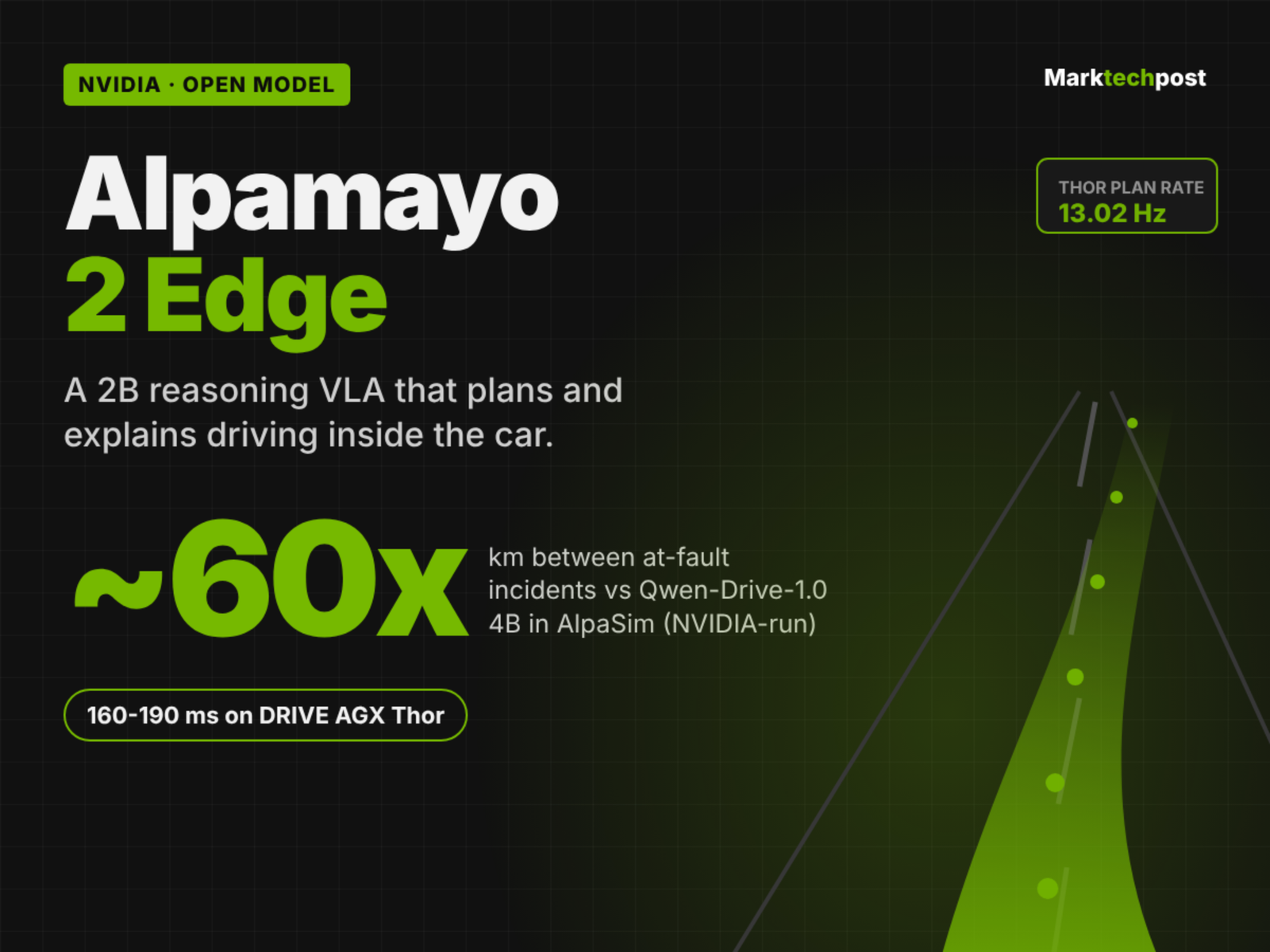


NVIDIA has released Alpamayo 2 Edge, a compact reasoning vision-language-action (VLA) model for autonomous driving. Alpamayo 2 Edge is a 2B-parameter model that plans trajectories and explains them inside the vehicle. It targets NVIDIA DRIVE AGX Thor, not a datacenter GPU. The goal: reasoning-based planning within onboard compute and latency budgets. You can check the deployment options and specs here through our GPULeaderboard.com chrome extension.
TL;DR
- Size: 2B-class. Card breakdown: 2.45B backbone + 0.2B action expert (HF metadata says 3B). Context length: not disclosed (measured prompt: 3,236 tokens).
- Runs on: NVIDIA DRIVE AGX Thor with the FP8 + TensorRT Edge-LLM recipe. BF16 PyTorch needs 16 GB+ GPU memory, validated on 1x H100 80GB.
- Performance: Strong closed-loop driver for its size; mid-pack on reasoning QA.
- Best: 15.15 km per at-fault incident in AlpaSim, about 60x Qwen-Drive-1.0 4B (0.25 km).
- Worst: nuReasoning numeric score of 48.67; LingoQA 75.2 trails Alpamayo 2 Super (79.2).
- Bottom line: Best: reasoning-based planning at 160 to 190 ms on in-car hardware. Worst: only H100 validated, and real-time Thor speed needs the FP8 recipe.
What is Alpamayo 2 Edge?
Alpamayo 2 Edge is an open NVIDIA VLA model that turns surround-camera video into a 6.4-second plan. It is the in-car member of the Alpamayo family, next to the 34B cloud model Alpamayo 2 Super.
Per the model card, the 2.45B backbone pairs a 1.96B language model with a 0.41B SigLIP2 encoder. A 0.2B diffusion action expert sits on top. The backbone comes from NVIDIA Cosmos 3 Edge and is Nemotron-based. NVIDIA markets the model as 2B, while Hugging Face metadata shows 3B.
What goes in and what comes out?
For trajectory prediction, the model reads 6 cameras and 22 frames per observation. The 2 front cameras give 5 frames each, the other 4 give 3 each. It also takes a navigation instruction and 20 historical ego poses.
Output is 64 waypoints from 0.1 to 6.4 seconds. The action expert predicts acceleration and curvature, then a unicycle model integrates them. The text output is a Chain-of-Causation (CoC) reasoning trace. The model also answers free-form questions about a driving scene.
How does adaptive reasoning work?
During routine driving, the model emits special <NOMINAL> tokens instead of a full reasoning trace. It writes CoC reasoning only when a scene needs it. Fewer tokens means less compute per planning step.
How was Alpamayo 2 Edge trained?
NVIDIA team lists these ingredients:
- Offline distillation from CoC autolabels generated by Alpamayo 2 Super.
- About 115,000 hours of multi-camera driving video and about 3.7M CoC traces.
- Closed-loop RL post-training in AlpaGym, learning from its own actions in simulation.
- Multi-resolution inputs for cheaper encoding of surround views.
How fast does it run on DRIVE AGX Thor?
Hugging Face weights ship in BF16 and run as a PyTorch model. Real-time use on Thor needs the Alpamayo Developer Hub recipe. It stages the checkpoint and the DFlash2 drafter, then calibrates FP8 scales. Next it exports ONNX graphs and builds TensorRT engines with TensorRT Edge-LLM plugins.
NVIDIA reports 160 ms to 190 ms pixel-to-trajectory latency, depending on how much the model reasons. The reference setup is DRIVE AGX Thor-X with DRIVE OS 7.2.7.0, CUDA 13.4 and TensorRT 11.3.1.9. In NVIDIA’s demo video, PyTorch BF16 plans at 0.76 Hz. The optimized FP8 Thor pipeline plans at 13.02 Hz in AlpaSim. Partner Embedl says it reached 10 Hz on AGX Thor in under 48 hours.
On a workstation GPU, the card recommends at least 16 GB of memory. NVIDIA measured 12.06 GiB peak process memory on 1 H100 with 6 trajectory candidates. Other GPU architectures are not yet validated.
How does Alpamayo 2 Edge score on benchmarks?
NVIDIA compares Edge with Alibaba’s 4B Qwen-Drive-1.0. In AlpaSim closed-loop driving, Edge covers 15.15 km between at-fault incidents versus 0.25 km. That is about 60x. Open-loop minADE is 0.53 m versus 1.68 m. Both are NVIDIA’s own runs.
The model card adds:
- AlpaSim: 15.15 ± 0.04 km per at-fault incident over 875 NuRec scenarios, 3 rollouts.
- Open-loop minADE_6 at 5 s: 0.52 m on 1,392 PhysicalAI-AV samples.
- LingoQA (Lingo-Judge): 75.2.
- SURDS: 86.50, KITScenes scene: 89.46, nuReasoning numeric: 48.67.
How does Alpamayo 2 Edge compare with other driving VLAs?
AlpaSim metrics differ across sources (km per incident vs AlpaSim Score vs at-fault score), so compare only within a row’s same metric.
What else shipped with it?
NVIDIA also released AlpaJudge, a human-calibrated judge for reasoning traces. It scores traces, filters training data and supplies RL rewards. As an RL reward, it lifted reasoning quality 10.2% (judge) and 11.4% (human).
Availability and license
Weights use the OpenMDW-1.1 license, and code uses Apache 2.0. Inference code is on GitHub. The model supports fine-tuning.
Key Takeaways
- 2B-class reasoning VLA built to run inside the car on DRIVE AGX Thor.
- Adaptive reasoning: <NOMINAL> tokens skip CoC traces in routine driving.
- 160 ms to 190 ms pixel-to-trajectory latency with the FP8 TensorRT recipe.
- 15.15 km per at-fault incident in AlpaSim, about 60x Qwen-Drive-1.0 4B.
- Weak spot: LingoQA 75.2, behind Alpamayo 2 Super and Qwen-Drive-1.0.
Check out the model card, the technical blog and the GitHub repo. You can check the deployment options and specs here through our GPULeaderboard.com chrome extension.
Also, feel free to follow us on Twitter and don’t forget to join our 150k+ML SubReddit and Subscribe to our Newsletter. Wait! are you on telegram? now you can join us on telegram as well.
Need to partner with us for promoting your GitHub Repo OR Hugging Face Page OR Product Release OR Webinar etc.? Connect with us
Asif Razzaq is the CEO of Marktechpost AI Media Inc.. As a visionary entrepreneur and engineer, Asif is committed to harnessing the potential of Artificial Intelligence for social good. His most recent endeavor is the launch of an Artificial Intelligence Media Platform, Marktechpost, which stands out for its in-depth coverage of machine learning and deep learning news that is both technically sound and easily understandable by a wide audience. The platform boasts of over 2 million monthly views, illustrating its popularity among audiences.



