
XRP Ledger’s booming activity faces scrutiny as 110 bot wallets dominate RLUSD payments



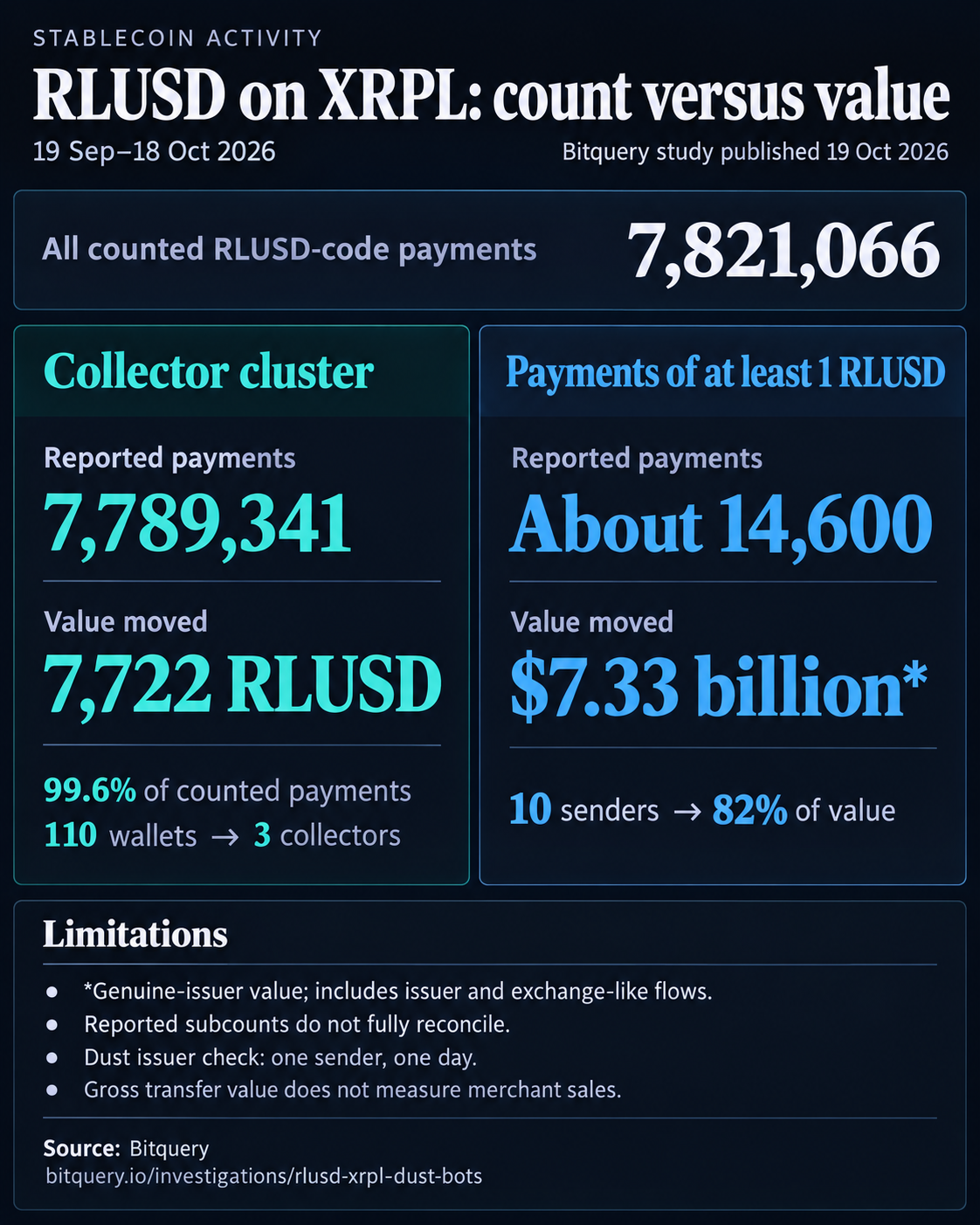
Just 110 wallets generated 99.6% of RLUSD payments on the XRP Ledger (XRPL) over 30 days, blockchain analytics firm Bitquery found.
The wallets executed approximately 7.79 million transactions between Sept. 19 and Oct. 18, transferring just $7,722 worth of Ripple’s dollar-backed stablecoin, according to an Oct. 19 investigation.
Each payment averaged roughly $0.001, with the funds repeatedly flowing into three collector addresses. The activity accounted for nearly all 7.82 million RLUSD payments recorded during the period, raising questions about how much of the stablecoin’s surging transaction count reflects genuine adoption.
The impact extended across the wider XRPL. Between Oct. 8 and Oct. 14, the same wallet cluster generated 1.58 million of the network’s 3.47 million account-to-account payments, representing 45.6% of all such activity across cryptocurrencies.
The concentration was particularly striking on Sept. 26, when RLUSD recorded 573,589 payments, but only 388 involved transfers worth at least $1.
The findings complicate efforts to measure RLUSD adoption through transaction counts as Ripple expands its stablecoin infrastructure into traditional finance.
However, Bitquery also identified substantial high-value activity beneath the automated transfers. During the period, approximately 14,600 payments worth at least $1 moved $7.33 billion, with just 10 wallets accounting for $6.05 billion, or 82% of the total.
The automated wallets were funded through addresses labeled as belonging to Binance, while collected funds were routed back through exchange-like deposit accounts. Bitquery could not establish who operated the cluster.

The operation was relatively inexpensive. The wallets spent approximately 495 XRP, valued at $648, on fees across 8.6 million transactions, including transfers involving XRP itself.
Automated traffic collapses as Ripple expands banking access
Unusual transaction activity began declining sharply on Oct. 14, just before Cross River Bank announced it was integrating RLUSD into its core banking infrastructure.
Bitquery found that payments to the largest collector dropped from approximately 8,200 per hour to 1,200 that evening before stopping early on Oct. 15. Activity at another collector fell from 1,600 hourly payments to about 11 by Oct. 16.
The slowdown coincided with Cross River’s Oct. 15 announcement that it had incorporated RLUSD into its banking platform, allowing eligible fintech companies to access stablecoin payments and round-the-clock settlement through a single API.
The integration represents a commercial expansion for Ripple, potentially connecting RLUSD to traditional banking customers seeking faster cross-border payments and treasury transfers.
Bitquery found no network fee increase or protocol change explaining the abrupt decline in automated transfers. Blockchain records also show no evidence linking the cluster’s shutdown to Cross River’s announcement.
By Oct. 17, daily RLUSD payments had fallen to approximately 2,000, dramatically below the more than 500,000 transactions recorded during September’s peak.
Meanwhile, the remaining high-value activity showed signs of concentrated institutional settlement. Just 828 payments worth at least $1 million accounted for $6.98 billion, or approximately 95% of the larger-payment volume.
Another $1.47 billion involved RLUSD minting and redemptions through the issuer, while two wallets exchanged $424 million in both directions, contributing $848 million to gross transfer volume without sending funds to additional counterparties.
These patterns suggest that much of RLUSD’s existing transaction value is concentrated among issuers, exchanges and large settlement accounts, leaving Ripple with the challenge of expanding usage among independent businesses.



