
JD.com expands physical AI in logistics with 3 million robots
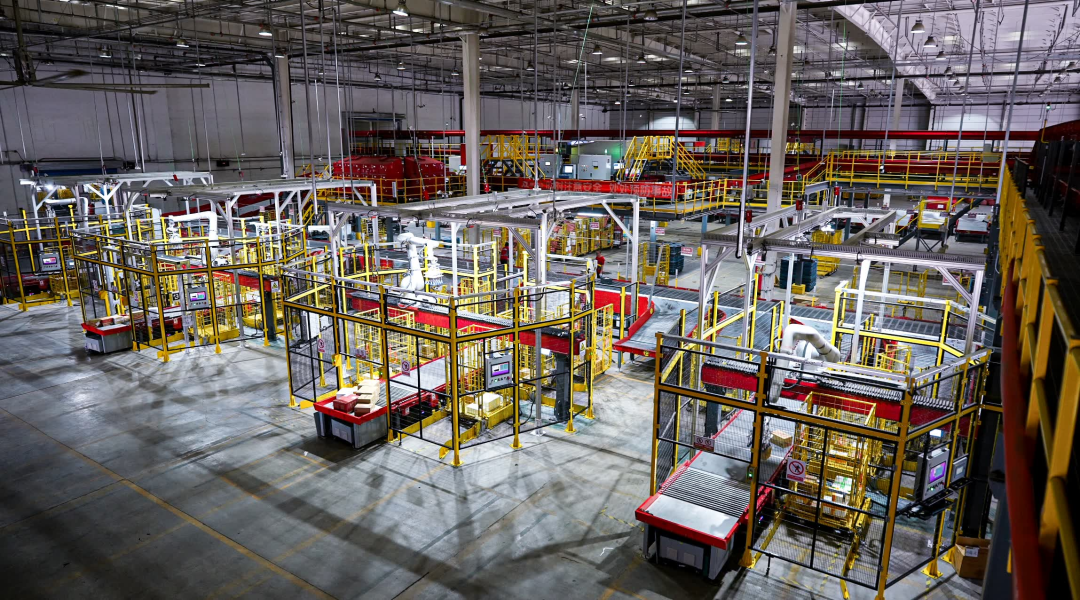


JD.com is expanding AI and robotics across its logistics network under a new Physical AI Acceleration Plan, while reiterating a five-year target to procure 3 million robots, 1 million autonomous vehicles, and 100,000 delivery drones.
The company launched the plan at JDDiscovery 2026 in Beijing. JD Logistics also unveiled its industrial Wolf Robot series, designed for tasks across warehousing, sorting, transport, and delivery.
Specialised systems include equipment designed to operate in temperatures as low as minus 20 degrees Celsius, automated pharmacy dispatch systems, autonomous delivery vehicles, and drones.
The five-year procurement plan builds on automation that JD Logistics already has in operation. As of June 30, its LangzuTech Goods-to-Person automated warehousing system had been deployed in more than 30 warehouses across China, with deployments also launched in the UK and Germany.
JD Logistics’ broader warehouse network included more than 1,800 self-operated warehouses and more than 2,000 third-party cloud warehouses on its Open Warehouse Platform as of June 30. The network covered more than 36 million square metres in aggregate.
The company also had thousands of unmanned vehicles in regular operation across more than 20 Chinese provinces by the end of June. More than 100 domestic drone routes were operating across applications including parcel and food delivery, emergency medicine transport, and disaster relief.
From AI decisions to physical execution
JD Logistics is connecting its physical equipment with Meta Brain, an AI system used across warehousing, transportation, and delivery. JD said Meta Brain 3.0 can calculate optimal routes for hundreds of millions of parcels in seconds, compared with minutes previously.
Meta Brain also powers JD Logistics’ LangzuTech Packer robotic arm, which combines the model with multimodal sensor data to track, grasp, and place parcels with different shapes.
JD Logistics said in a first-quarter regulatory filing that the Packer uses parallel reinforcement learning in simulated environments to optimise parcel-placement sequences and loading layouts. The company said the system is designed to improve sorting efficiency and the use of available carrier space.
JD upgraded the robotic arm’s force-control technology during the second quarter to support more precise cage-loading operations. By June, the Packer was operating around the clock at multiple JD Logistics parks, according to the company’s interim report.
JD is also adding computing capacity to support AI development. JD Cloud plans to work with Chinese chipmaker Moore Threads on a cluster containing 100,000 GPUs for large-model training, inference, and embodied-AI workloads.
The two companies have previously worked on a 10,000-GPU cluster, according to Data Center Dynamics. Details of which Moore Threads GPU models will be used in the planned 100,000-GPU system have not been disclosed.
JD Cloud also plans to collect more than 10 million hours of video showing real-world human activities over the next two years for embodied-AI training.
Beyond warehouse operations, JD Logistics has expanded its autonomous vehicle network into night-time delivery. Its interim report said the company had launched night-time autonomous routes in Shenzhen, allowing vehicles to operate around the clock.
JD is also using drones in rural logistics. In June, JD Logistics launched a drone delivery network in Zizhong, Sichuan province, covering 78 administrative villages, and said deliveries to some mountain villages could be completed in as little as seven minutes.
Scaling automation across JD’s logistics network
JD did not disclose the total expected cost of the five-year procurement programme at JDDiscovery or provide a network-wide return-on-investment target.
JD Logistics spent RMB2.3 billion on research and development during the first half of 2026, up 23.7% from RMB1.9 billion a year earlier. The company attributed the increase to continued investment in technology and innovation but did not provide a breakdown showing how much was spent specifically on AI or robotics.
Depreciation of property and equipment and amortisation of other intangible assets rose 18.7% to RMB2.6 billion during the first half of 2026, from RMB2.2 billion a year earlier. JD Logistics attributed the increase mainly to additional logistics equipment and vehicles.
Purchases of property and equipment and investment properties totalled RMB3.09 billion over the same six-month period, compared with RMB2.70 billion a year earlier. Those figures cover the wider logistics business and are not disclosed as spending specifically associated with the new physical AI programme.
JD’s automation plans also come as China’s major ecommerce platforms expand fulfilment infrastructure. Reuters reported on September 3 that competition between JD.com, Alibaba, and Meituan had moved from heavy spending on delivery subsidies towards logistics infrastructure, broader supply, and order-level economics.
Alibaba and JD have been opening dark stores and fast-fulfilment “lightning warehouses” in densely populated areas to support deliveries within an hour, while Meituan has been building supermarkets to expand its grocery operations. Ministry of Commerce research cited by Reuters estimates China’s instant-retail market will reach RMB1.2 trillion, or about $178 billion, by the end of 2026.
JD and companies within its ecosystem employ around 700,000 delivery and logistics personnel, according to the South China Morning Post.
JD founder Richard Liu said earlier this year that robots would eventually take over parcel-delivery work now carried out by human couriers. The Financial Times reported in June that JD had signed agreements with around 120 educational institutions to retrain workers for roles including robot repair and maintenance.
JD said JD Logistics currently operates eight robot repair centres in China and plans to expand its robotics after-sales capabilities over the next five years. The company expects the expansion to support more than 100,000 robotics service engineer jobs.
(Photo by JD.com)
See also: Arm launches Total Design for Physical AI and robotics framework
Want to learn more about AI and big data from industry leaders? Check out AI & Big Data Expo taking place in Amsterdam, California, and London. The comprehensive event is part of TechEx and is co-located with other leading technology events including the Cyber Security & Cloud Expo. Click here for more information.
AI News is powered by TechForge Media. Explore other upcoming enterprise technology events and webinars here.


